
Journalists and activists should choose a VPN by ownership, a specific no-logs policy and a track record under legal pressure, after writing a threat model. A VPN hides browsing from the local network and internet provider and hides your IP address from websites. It does not make you anonymous: use Tor for anonymity-critical work, plus Signal and a locked-down phone.
 Team BoycatUpdated Oct 22, 2026
BuycatVPN
A no-logs VPN for iOS, Android, Mac, Windows and Linux.
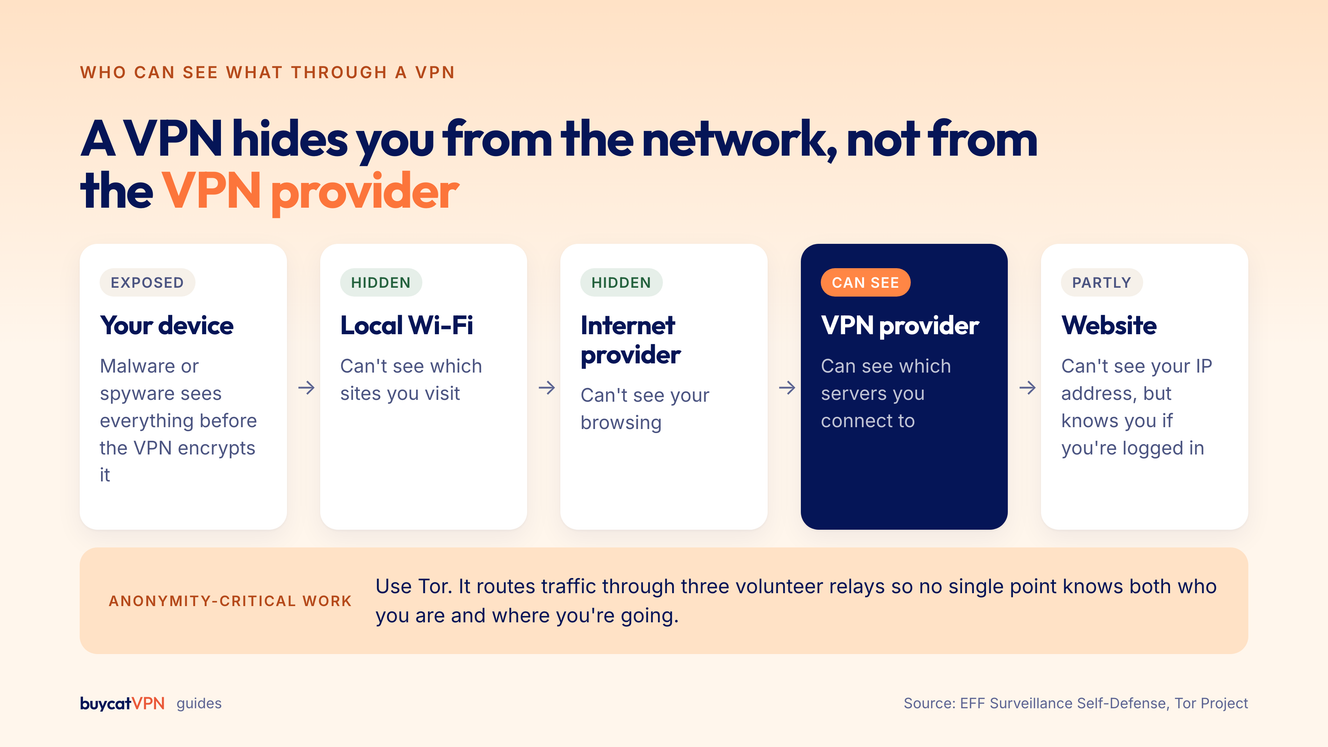
Choose a VPN for high-risk work by writing a threat model first, then checking the provider's owner, logging policy and track record under legal pressure. A VPN hides your browsing from the local network and your internet provider, and your IP address from the sites you visit. It does not make you anonymous.
Start with four questions, the framework the Electronic Frontier Foundation (EFF) uses in Surveillance Self-Defense. A threat model is your short written answer to who might target you, what they want and what they can do.
A VPN protects your traffic on the way out of your device and hides where you connect from.
A VPN does not protect you from the VPN company, your own accounts and devices, or a well-resourced adversary.
Check the owner, the logs and the legal track record first, then the features.
| Check | Why it matters for you |
|---|---|
| Owner and legal entity | Decides who can be pressured or ordered to hand over data |
| Specific no-logs policy | No browsing, DNS, timestamps or source IPs stored |
| Track record | Court cases or raids where nothing was handed over |
| Payment and signup | Can you pay without linking your name? Some providers accept cash or don't require email |
| Kill switch or always-on | Stops traffic leaking if the VPN drops |
| Modern protocols | WireGuard or OpenVPN, never PPTP |
| Obfuscation | Helps on networks that block VPN traffic |
To find the legal entity behind a brand, see who owns your VPN. Track records show policies under test:
Mullvad, which doesn't require an email, is often recommended for high-risk users.
Use Tor when anonymity really matters, and a VPN for general privacy and speed.
For sensitive research, many trainers recommend Tor Browser for the research itself and a VPN for everything else on the device.
Using Tor or a VPN can itself be noticeable on a monitored network, and may be restricted in some countries.
A VPN covers the network. These cover the rest.
Prepare before you leave, and assume your phone still reveals your location.
Buycat VPN is an everyday privacy layer, not a Tor replacement.
Buycat VPN offers one-tap connect, WireGuard, obfuscation on Plus and Pro, and apps on every major platform. It is independently owned by Boycat rather than a VPN conglomerate.
For the highest-risk work, be honest with yourself about the threat model: use Tor for anonymity-critical research, and prefer providers with a long public track record under legal pressure.
A VPN is a useful baseline for journalists on shared or monitored networks and for hiding their IP address from research targets. It is one layer of protection, not full protection.
No. A VPN hides your traffic from the local network and your IP address from websites, but the VPN provider, your logged-in accounts and your device can still identify you.
Use Tor for anonymity-critical work and a VPN for general privacy and speed. Many people use both for different tasks.
Clear ownership, a specific no-logs policy, a track record under legal pressure, private payment options, an always-on mode or kill switch, and obfuscation.
Only partly. A VPN hides your browsing from the network, but your carrier still sees your phone's location, so lock your phone with a passcode and carry minimal data.
Short, practical guides on staying private online, plus Buycat VPN news and offers. Unsubscribe any time.
Related guides
BuycatVPN
A no-logs VPN built around your privacy.
AES-256 encryption on iOS, Android, Mac, Windows and Linux. 30-day money-back guarantee on your first web purchase.
Get BuycatVPN
