
You can test a VPN's no-logs claim seven ways: read what the policy says is stored, find the legal entity and jurisdiction, look for an independent audit, check court cases, look for raids, review the app's permissions and privacy label, and run DNS and IP leak tests. A real no-logs policy names what isn't stored: browsing history, DNS queries, traffic content, connection timestamps and source IPs.
 Team BoycatUpdated Oct 22, 2026
You can't inspect a VPN's servers, but you can test its no-logs claim with seven checks, from a five-minute read of the privacy policy to court records. "No logs" has no legal definition and nobody outside the company can see its servers, so the best you can do is gather evidence. Here are the seven tests, ordered from quickest to strongest.
VPN logs fall into three groups, and a privacy VPN should never keep the first one.
A "no logs" claim that only covers activity logs can still let a VPN link a session back to you through connection logs.
A trustworthy policy lists exactly what is not collected. Open it and search for "log", "IP address", "timestamp", "retain", "aggregate", "third party" and "law enforcement".
Good signs:
Red flags:
The terms of service name the legal entity that runs the VPN, and that entity's jurisdiction decides which courts can order data.
Search that name in the national company registry or OpenCorporates, and look for a parent company. The parent decides whose incentives you're trusting. See who owns your VPN and who owns VPN review sites.
An audit means an outside security firm checked the servers, code or processes against the policy. Look for:
No audit doesn't prove logging, but a published, recent, full-scope audit is strong evidence.
The best proof is when someone with a warrant tested the claim.
Search "[VPN name] subpoena", "[VPN name] court" and "[VPN name] logs FBI".
When police seize a VPN's servers or visit its office, the outcome is public evidence.
In 2023, Swedish police came to Mullvad's office with a search warrant. Mullvad says they left without customer data because none existed (Mullvad). Check whether the VPN publishes these events or a transparency report.
The app's privacy label, permissions and trackers show what it collects on your device.
Leaks aren't logs, but a leak test shows whether your data goes where the VPN says.
Run the IP and DNS checks twice: once right after connecting, and again after your Wi-Fi drops and reconnects.
Marketing claims are the weakest evidence, and a court case or raid with nothing handed over is the strongest.
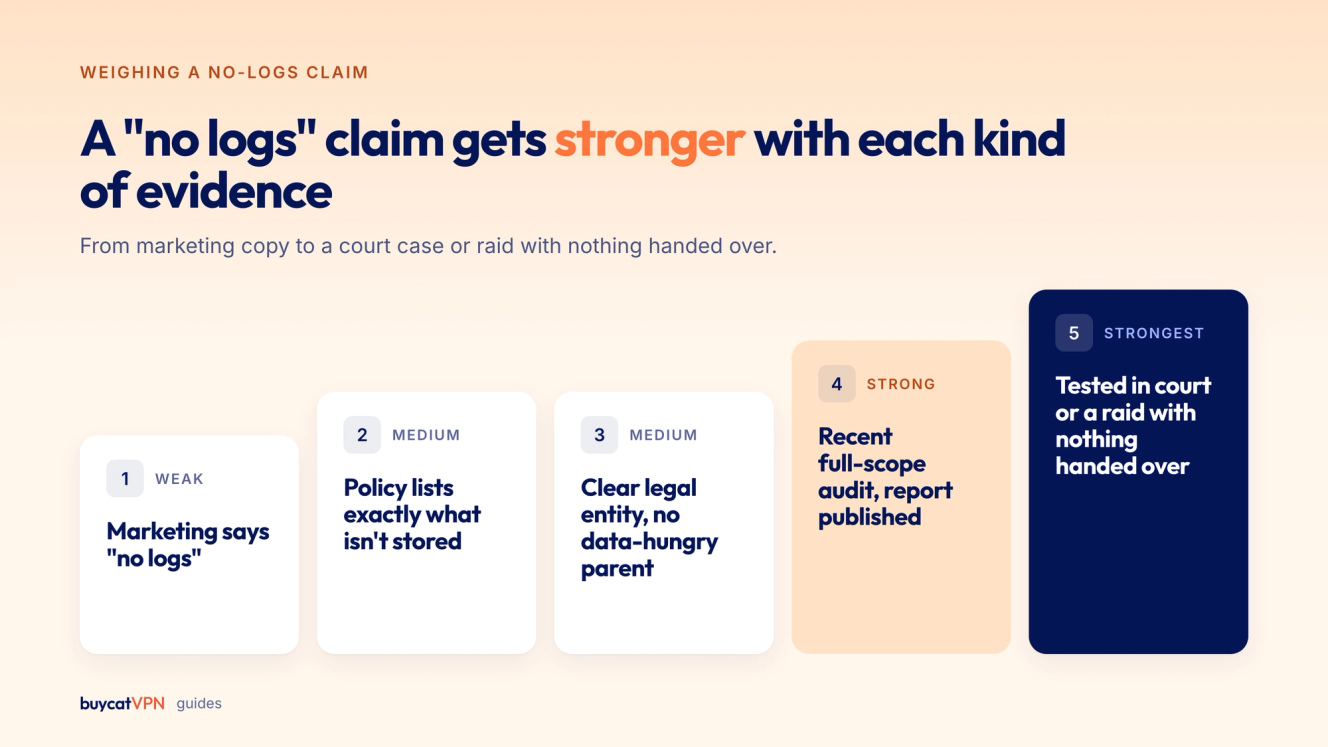
| Evidence | Strength |
|---|---|
| Marketing says "no logs" | Weak |
| Policy lists exactly what isn't stored | Medium |
| Clear legal entity, no data-hungry parent | Medium |
| Recent full-scope audit, report published | Strong |
| Tested in court or a raid with nothing handed over | Strongest |
Start with tests 1, 6 and 7, which you can do yourself today, then look for audits, court cases and raids.
We hold Buycat VPN to the same test. Buycat VPN's privacy policy states that we don't store browsing history, DNS queries or traffic content. The legal entity is Boycat, with no parent conglomerate.
We haven't published a third-party audit yet, and we'll link the report here when we do. Until then, judge us on the policy wording and run the leak tests yourself within our 30-day money-back window.
Read exactly what its privacy policy says is stored, check for a recent published audit, search for court cases or police requests involving it, and run DNS and IP leak tests.
A no-logs VPN should not store your browsing history, DNS queries, traffic content, or connection data that links a session to you. Check the policy for that list.
Activity logs record sites visited, DNS queries and traffic content. Connection logs record when you connected, from which IP address, to which server and how much data, which can still link a session back to you.
Technically, a VPN can see which servers you connect to. HTTPS hides page content, but the VPN can still see domains. A no-logs VPN commits to not recording them.
Yes. Private Internet Access couldn't provide user logs in FBI cases in 2016 and 2018. PureVPN, which also claimed no logs, did provide records in 2017.
A VPN audit is strong evidence for the period and systems audited. Check the scope and date before relying on it.
In Learn
What is a No-Logs VPNShort, practical guides on staying private online, plus Buycat VPN news and offers. Unsubscribe any time.
BuycatVPN
A no-logs VPN built around your privacy.
AES-256 encryption on iOS, Android, Mac, Windows and Linux. 30-day money-back guarantee on your first web purchase.
Get BuycatVPN
